2024 was a challenging year, both politically and economically. The end of the traffic light coalition under Chancellor Olaf Scholz meant that a number of planned reforms could no longer be implemented during the legislative period. How did this affect the German Pension Insurance?
Hildebrandt: The premature dissolution of the government coalition was unexpected, but it had no impact on the work of the German Pension Insurance. Legal provisions are in place to guarantee the payment of statutory pension insurance benefits and the necessary funding at all times. The contribution rate of 18.6 per cent continues to apply and the next pension adjustment will take place, as both are determined according to clear rules.
Jöris: Unfortunately, some pension policy initiatives relating to pension insurance could not be implemented. Specifically, I’m talking about Pension Package II, an initiative designed to stabilise the pension level at 48 per cent of the average wage and increase in the minimum reserve from 0.2x to 0.3x monthly expenditure. The German Pension Insurance’s self-government body had been lobbying for a higher minimum reserve for a long time. The Generation Capital Fund that was put forward as a counter-proposal to the Free Democrats’ equity pension proposal – a publicly managed fund to which a share of two percentage points of the pension insurance contributions of all insured persons should be allocated – was not implemented and, as a pension insurance institution, we have always spoken out against using pension contributions to build capital stock.
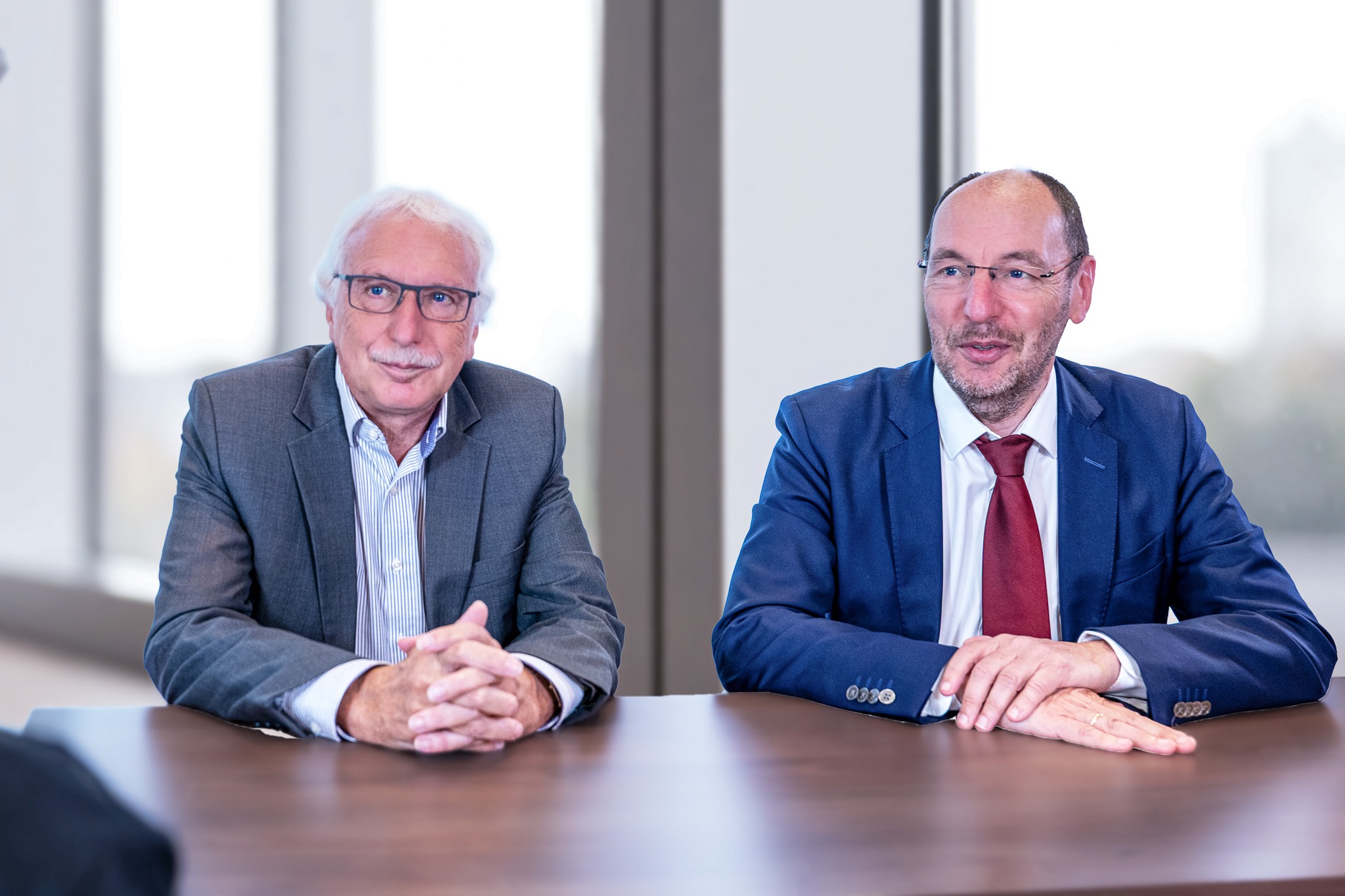
Uwe Hildebrandt represents the insured persons as Alternating Chair of the Federal Board of Deutsche Rentenversicherung Bund. Until the beginning of 2025, he held the position of Regional Chairman for South-West Germany of the Food, Beverages and Catering Union (NGG).
Heribert Jöris represents the employers as Alternating Chair of the Federal Board of Deutsche Rentenversicherung Bund. He has been Managing Director for Social and Collective Bargaining Policy at the German Construction Industry Federation (ZDB) since 2017.
What are you hoping for from the next government? Which key policy areas does it have to tackle?
Hildebrandt: It will be important to address the issue of introducing mandatory contributions to pension schemes for the self-employed – an issue that has been on our minds for many years. Many self-employed people face the risk of poverty in old age and this is a gap in the old-age pension system that we need to close. Also, if even more improvements to maternity pension benefits are introduced, it has to be clear that they should be financed with the federal budget – and not with pension contributions.
Jöris: In my view, we need a financially sustainable, reliable and socially equitable pension policy that puts equal emphasis on the interests of benefit recipients and contributors. Not only would this entail boosting the liquidity of the pension insurance scheme, but also the restructuring of federal subsidies as envisaged in Pension Package II. Specifically earmarking federal subsidies could help to prevent them being cut in order to consolidate the federal budget – there must be no budgetary policy-motivated federal subsidy cuts! One thing tends to be forgotten in the policy debate process: government funds are not a financial injection to keep the pension insurance scheme alive. Rather, federal subsidies are the proper means to finance benefits not covered by pension contributions. As such they are a societal responsibility that should be funded by all taxpayers and thus by the federal government.
How did the German Pension Insurance’s finances fare in light of this?
Jöris: The German Pension Insurance will remain on a solid financial footing if non-insured benefits that are not covered by pension contributions are consistently counter-financed by tax revenue. This is mainly due to the fact that income from people in gainful employment subject to contributions has grown steadily in recent years. Last year, gross wages and salaries rose by a full 5.0 per cent and the labour market remained stable. These developments drove our 5.6 per cent growth in revenue to 305.9 billion euros between 2023 and 2024. On the other side of the equation, expenditure increased by 6.1 per cent to 402.8 billion euros.
Hildebrandt: Demographic developments did contribute to growth in expenditure in 2024, though to a lesser extent. The lion’s share of the increase in expenditure is attributable to the very generous pension adjustments. On 1 July 2024, the current pension value increased by 4.57 per cent to 39.32 euros. This has significantly improved the pension benefits for around 21 million pensioners. Significant improvements to benefits were also implemented for recipients of reduced earning capacity pensions.
Prevention and rehabilitation services are another core responsibility of the German Pension Insurance. What is the current status of these services?
Jöris: Prevention and rehabilitation play a key role in keeping people in employment and returning them to employment in the long-term, which is important in light of longer lifespans and demographic change. Employees can take advantage of the RV Fit prevention programme as soon as they experience their first health impairments. The total number of medical rehabilitation treatments provided has climbed back to 1,050,386 after the pandemic-related decline. An increasing number of people are choosing to exercise the recently revised statutory right to have a say in choosing rehabilitation clinics, and more than 60 per cent of medical rehabilitation service applicants requested a specific clinic. We have also observed an increase in mental illness treatments – albeit with a gender-specific difference: around 21 per cent of women take advantage of rehabilitation treatments for mental or psychosomatic illnesses compared to only 13 per cent of men.
What developments does the German Insurance pursue in the area of digitalisation?
Hildebrandt: In an increasingly digital world it’s important to have a robust IT infrastructure. The increasing risk posed by cybercrime means that our systems need comprehensive protection. We are currently testing various AI applications to further improve our performance. AI can potentially reduce the workload for our employees across numerous departments. It is also associated with benefits for insured persons as customer services have been improved. In essence, we see digitalisation as a tremendous opportunity, particularly against the background of a double demographic shift. Our workloads are increasing due to the fact that children born in high birth rate years are gradually reaching retirement age, while more and more people in gainful employment are retiring. To cope with the higher workloads and to maintain our efficiency and performance levels, we need to digitalise our processes. We have no alternative but to automate the tasks that can be automated. It remains essential for us that technology supports us in performing our work.
Jöris: Yes, digitalisation should benefit people, both the insured persons and our employees. The number of users submitting applications online has increased tenfold since the onset of the pandemic. As a result, we have significantly reduced our paper consumption. The number of sheets of paper printed out in 2024 was 154 million less than in 2018.

The final report on the 2023 social elections was presented last year. What insights did it provide you with?
Hildebrandt: Firstly, we have succeeded in significantly increasing the number of female members in the self-government bodies, even at the social insurance institutions where the women’s quota is only facultative. The candidate lists for social elections should ideally contain an equal proportion of women and men, and at least 40 per cent women. Secondly, online elections were held as part of a pilot project that initially involved five statutory health insurance funds. It represented the first ever opportunity to vote online in a legally mandated election in Germany. However, despite this innovative approach, voter turnout was not as high as we had hoped for, especially among younger insured persons. To raise visibility in society and politics it is essential to teach a basic knowledge of the German social insurance system in schools and educational institutions. Enshrining the self-government of social insurance institutions in constitutional law would also increase public awareness. Despite all the progress we have made, this is the only way to be optimally positioned for the next social elections in 2029.
Social self-government is democracy in action. How do you see your role in these increasingly polarised times?
Jöris: Even though we are not yet constitutionally protected, we view ourselves as a vital element of democracy. Our democracy cannot function without social engagement on many different levels – from parliament to clubs. We embrace our responsibility to society as a whole and are committed to an open society and respectful coexistence in the spirit of our democracy. This is what we do in our daily work and, in concrete terms, self-government means that insured persons, pensioners and employers can elect their representatives from among themselves.